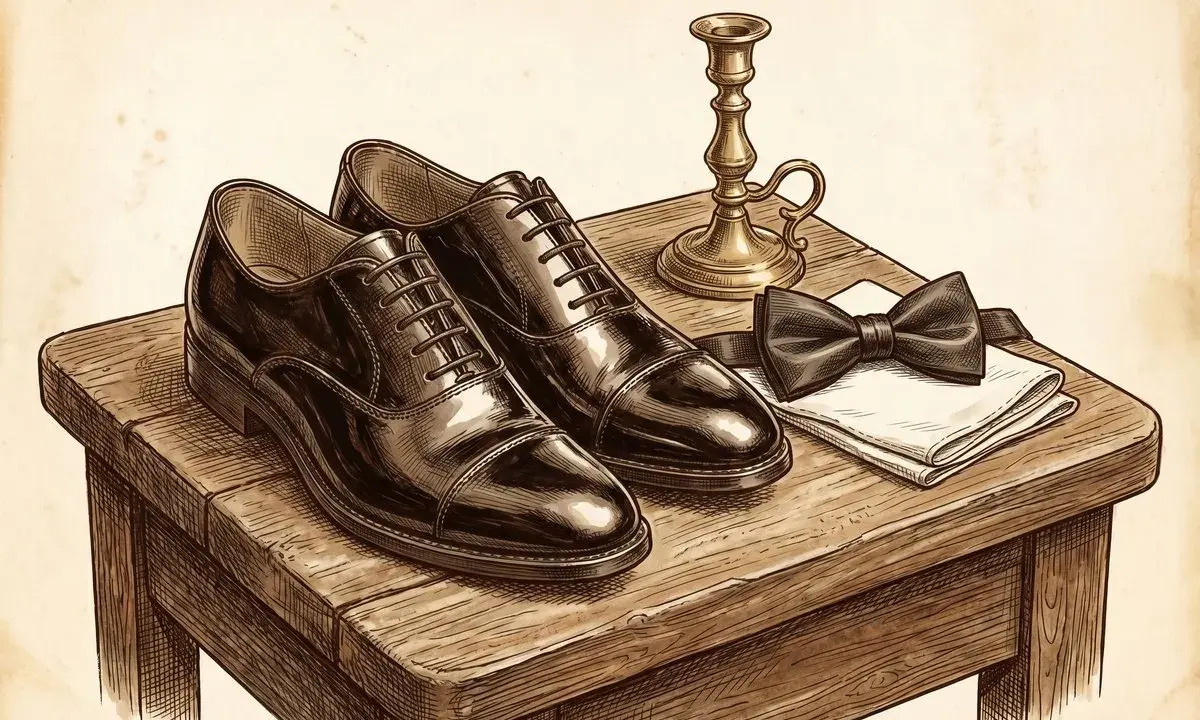
The safest rule is to keep the shoe black, sleek, and minimal
- Black patent leather Oxfords are the safest all-round choice for black tie.
- Plain-toe or wholecut black calf leather works when you want a quieter, less glossy look.
- Velvet slippers can be right for modern eveningwear, but they are a style choice, not the default.
- Opera pumps are the most formal option, though they are niche outside very traditional events.
- Brown leather, brogues, chunky soles, sneakers, and suede all weaken the look immediately.
What black tie expects from your shoes
Black tie is one of the few dress codes where footwear really matters. The jacket may do most of the visual work, but the shoes decide whether the outfit feels precise or improvised. I look for a shoe that disappears into the tailoring rather than competes with it.
That means closed lacing, a slim profile, a dark upper, and very little decoration. Open lacing, heavy stitching, thick rubber soles, decorative broguing, and bright contrast all move the shoe away from eveningwear and toward business or smart-casual territory. If the shoe looks like something you would wear to the office, it is usually the wrong choice for black tie.
In practical terms, this is why the safest answer is usually black and polished. Once those basics are in place, the actual style choice becomes much easier to rank.
The best shoe styles, ranked from safest to most expressive
When I narrow black-tie footwear down to the pairs that really work, the list is short. A tuxedo does not need a long menu of options; it needs the right one for the event, the room, and the level of formality expected.
| Style | Formality level | Best use | My view |
|---|---|---|---|
| Opera pumps | Highest | Very traditional black tie or white tie-adjacent occasions | Correct, elegant, and rare. I only reach for them when the event is genuinely formal. |
| Black patent leather Oxford | Very high | Classic black tie, weddings, galas, formal dinners | My default answer. It is the safest balance of formality, availability, and clarity. |
| Plain-toe or wholecut black calf Oxford | High | Black tie with a slightly softer finish | Excellent if you want less shine but still want to stay fully appropriate. |
| Velvet slipper | High, but conditional | Creative black tie, evening weddings, dinner jackets with personality | Works when the outfit is deliberate. Looks try-hard if the rest of the look is too standard. |
| Formal loafer or Belgian slipper | Moderate to high, depending on the pair | Modern black tie with a relaxed, fashion-led feel | I treat this as a style move, not a safe default. |
If I were dressing a client for a strict black-tie invitation in London, I would start with patent Oxfords almost every time. If the event is less formal, a beautifully polished calf Oxford can look sharper and quieter than a shiny patent pair, especially under softer evening light. That choice becomes even more interesting when you start looking at material and finish.
When velvet slippers work and when they don’t
Velvet slippers are the most misunderstood option in this category. They can look superb, but only when the rest of the outfit gives them a reason to exist. I think of them as a finishing statement, not a foundation.
They work best when the invitation has room for interpretation, such as a fashion-forward wedding reception, a private dinner, or an event where the jacket has some visual personality. A black velvet slipper is the safest version. Midnight blue velvet can also work, but it is easier to get wrong because it can drift into costume territory if the rest of the outfit is ordinary.
Where they fail is usually obvious. If the tuxedo is a standard rental, the shirt is plain, the bow tie is conservative, and the event is formal rather than creative, velvet slippers can feel like a separate idea forced onto the outfit. In those situations, a clean Oxford is almost always the smarter move. The next question, then, is what details separate a truly good shoe from a merely acceptable one.
The details that matter more than logos
For black tie, I care more about construction and finish than branding. A discreet shoe from a respected maker will often look better than a famous pair that is too bulky or too ornate. The shape has to support the outfit, not announce itself.
- Leather finish should be glossy if the shoe is patent, or deeply polished if it is calf leather.
- Toe shape should be clean and restrained, not long, squared, or exaggerated.
- Sole thickness should stay slim; heavy soles read as casual even when the upper is formal.
- Decoration should be minimal. I prefer plain fronts or very subtle seams over broguing.
- Lacing should be closed on Oxfords, because it keeps the shoe looking neat and dressy.
The shoes that break the dress code fast
There are a few shoe types I would rule out immediately for a tuxedo. Some are too casual, some are too busy, and some simply belong to a different dress code.
- Brown shoes are wrong for classic black tie, even if they are expensive or beautifully made.
- Brogues and wingtip styles add too much pattern and read as daytime dress.
- Derbies or bluchers feel too open and too ordinary for eveningwear.
- Chunky soles and commando-style tread destroy the elegance of the silhouette.
- Sneakers, boots, and suede shoes move the outfit away from formalwear immediately.
- Overbuilt loafers with heavy hardware often look like a compromise rather than a choice.
One point is worth stressing: not every loafer is wrong, but many loafers are. If the shoe has visible metal, thick welted edges, or a soft casual profile, I would leave it out of the black-tie rotation. A tuxedo needs precision, and sloppy footwear is the fastest way to lose it. The better approach is to match the shoe to the event, which is where the decision becomes practical.
How I would choose for different black-tie occasions
Not every black-tie event has the same temperature, tone, or formality. A wedding reception, a charity gala, and a private dinner do not all ask for the same level of restraint. I use that context to decide how conservative or expressive the shoes should be.
| Occasion | Best choice | Why it works |
|---|---|---|
| Traditional black-tie wedding | Black patent leather Oxford | It is clean, formal, and unlikely to clash with the rest of the room. |
| Creative evening wedding | Velvet slipper or polished calf Oxford | Gives you room for personality without looking careless. |
| Charity gala or awards night | Patent Oxford | Photographs well and reads as properly dressed from every angle. |
| Private black-tie dinner | Plain-toe or wholecut calf Oxford | Feels elegant without looking overly shiny or theatrical. |
| Most formal invitation possible | Opera pumps | They are the most traditional evening shoe and the most exacting choice. |
If I am uncertain, I always fall back on black patent Oxfords. They are the equivalent of speaking clearly in a room full of accents: nobody mistakes the message. The final step is deciding whether it makes sense to buy, rent, or simply refine the pair you already own.
How much to spend if you’ll wear them more than once
For a one-off event, many men are tempted to treat formal shoes as an afterthought. I think that is a mistake if the event matters. Shoes are one of the few parts of a tuxedo that people notice immediately, because they sit at the edge of the silhouette and reveal whether the outfit was considered as a whole.
If you are renting a tuxedo in the UK, the rental package may include shoes, but I would inspect them carefully. Rental shoes are often serviceable, yet they can be too wide, too worn, or too bland to carry the rest of the look. If the event is important, owning your own pair usually pays off in fit and finish alone.My rough guide is simple. If you wear black tie occasionally, buy one dependable pair in black patent or polished calf and keep it well maintained. If you attend formal events regularly, it is worth owning two: one patent pair for maximum formality and one plain calf pair for quieter occasions. That way the shoe follows the event instead of forcing the event to suit the shoe.
The final check I use before walking out the door
Before any formal evening, I run through a quick check on the shoes themselves. It takes less than a minute, and it removes the small mistakes that make a tuxedo look unfinished.
- Are the shoes black and clean, with no scuffs at the toe?
- Does the shape look slim and elegant rather than bulky?
- Are the soles discreet enough that they do not read as casual?
- Are the laces thin, black, and properly tied?
- Do the shoes match the level of formality in the jacket and shirt?
- If the shoes are patent, have you wiped away fingerprints and dust?
If all of that checks out, the footwear is doing its job: supporting the tuxedo, not distracting from it. That is the standard I use for black tie in the UK, and it is the one that keeps the whole look sharp from the first step to the last.